
JAIN EDUCATION
Background and Introduction
JAINISM OVERVIEW
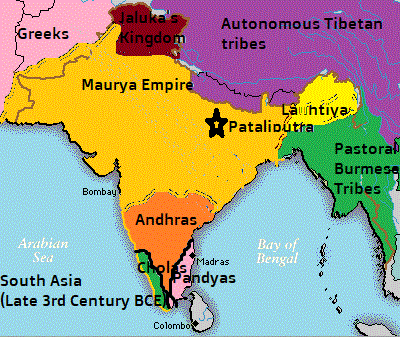
Jainism, at its most basic form, is one of the most ancient religions created in northeast India on the basis of non-violence (more commonly known as Ahimsa), non-attachment, and relative pluralism. Although famous scholars disagree with the exact timeline, the Jain religion was found between 2,500 to 3,000 years ago per confirmation from artifacts and scriptures.
By the third century BCE, Jainism spread to the south (Karnataka and Tamil Nadu) and the west (Gujarat, Madhya Pradesh, and Rajasthan). After India's independence, the religion expanded to eastern Africa, the United Kingdom, and North America. Across the globe, it is estimated there are over seven million adherents. The Jain religion later would inspire several principles practiced in Hinduism and Buddhism — applied by great leaders such as Mahatma Gandhi, Martin Luther King Jr., and Cesar Chavez.
JAIN TEMPLE
Today, thousands of Jain temples exist with major contributions in art, culture, and literature worldwide. Observing deeper into these temples, you will come across meticulous and intricate carvings, architectures, and paintings. Part of their blessings from the Jain temple arise from their strength and dedication to family, community, society, and the universe as a whole.


JAIN SYMBOLS
Breaking down the Jain symbol of values from inside outwards, we have a crescent moon with dots above, an Om symbol surrounded by a hand and palm, outlined by a universe outline, and the inscription Parasparopagraho Jivanam. The crescent with the dots above represent the homes of liberated souls (Moksha). The Om symbolizes the rebirth cycle of Jain cosmology — the four arms of life of animals and plants, humans, heaven, and hell. The hand represents Ahimsa, the non-violence pillar. The wheel represents the full life cycle, from birth to death.
JAIN RELIGION
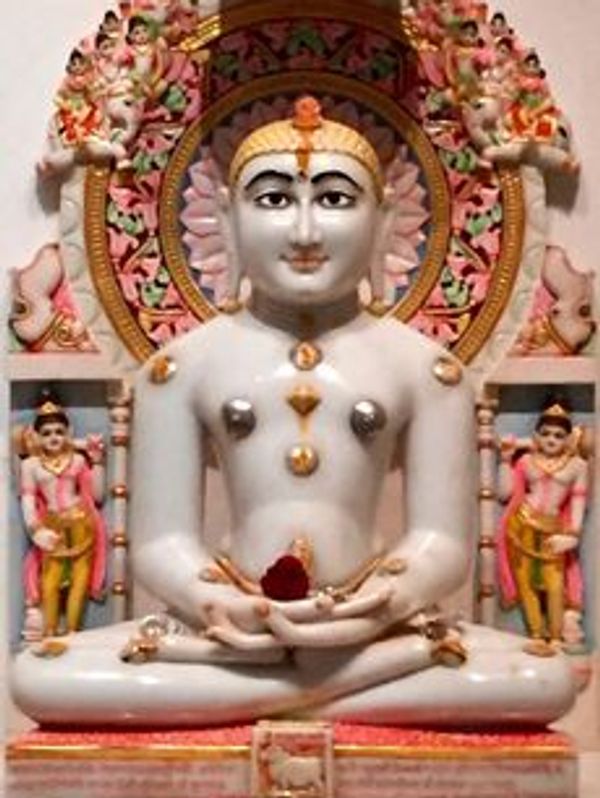
The Jainism founder, Lord Rishabhanatha, frequently referred to as the first tirthankara, lived over 8.4 million years ago. Jain religion itself derived from Jina, conqueror of inner vices. The religion paved a path for purification, renunciation and enlightenment, in which the ultimate eternal goal was liberation (Moksha) from rebirth — achievable over a lifetime by following the practices of Ahimsa and Karma.
In total, there are 24 tirthankaras (prophets). The most recent being Lord Mahavira, known as the Great Hero, who lived in 559 BCE and achieved Kevala (similar to nirvana in Buddhism). Jain scriptures reveal a strong correlation to environmental activism — protecting all living things and encouraging a strictly vegetarian diet, principles that influenced the Endangered Species Act of 1973.
SACRED JAIN PRAYERS
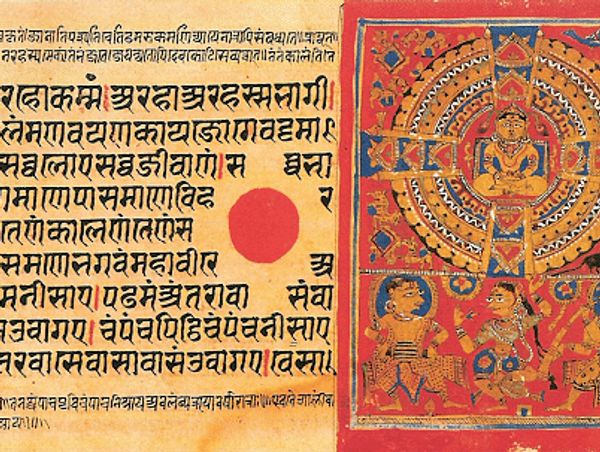
In Jain religion, the most sacred prayer is the Navkar Mantra, which is about salvation to all souls, no matter the religion or belief. For that reason, Jainism proudly supports Buddhism, Christianity, Hinduism, Islam, and many other religions. The religion encourages forgiveness, respect, selflessness, service, and simplicity. Interestingly, the Jain religion has no Bible version, but instead follows 45 scriptures. There is no middleman involved — just a connection between one's soul and God himself.
HOLY HOLIDAYS AND FESTIVALS
Here are the most celebrated holy holidays and festivals in Jainism and what they represent:
Paryushan
Eight-day holiday representing confession and forgiveness to others, self-discipline, and spiritual purification.
Daslakshan
Ten-day celebration by Digambar Jains. Ten days to celebrate ten cardinal virtues to uplift purification, self-reflection, and the way of Jain life.
Mahavir Jyanti
Birth of Lord Mahavira.
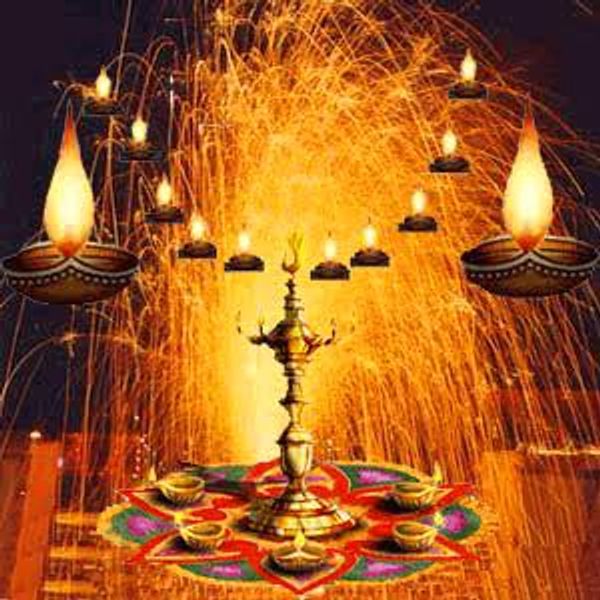
Diwali (New Year)
Enlightenment of Lord Mahavira. Also known as the 'Festival of Lights'.
Stay informed about our mission and your local Jain communities.